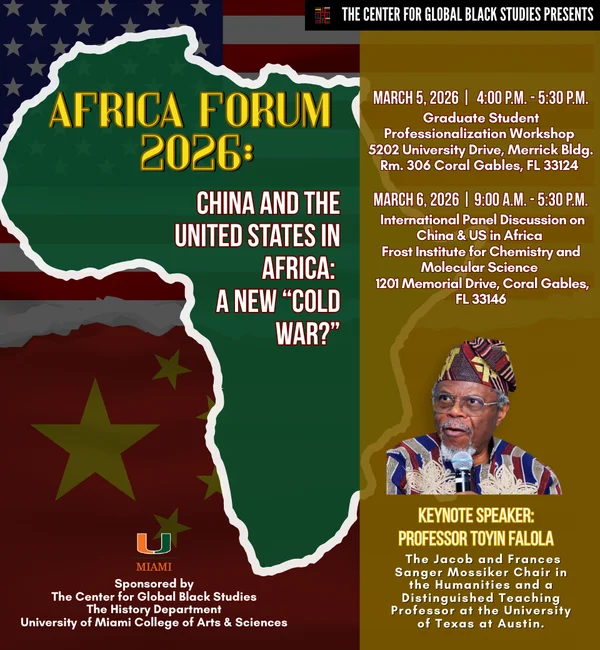
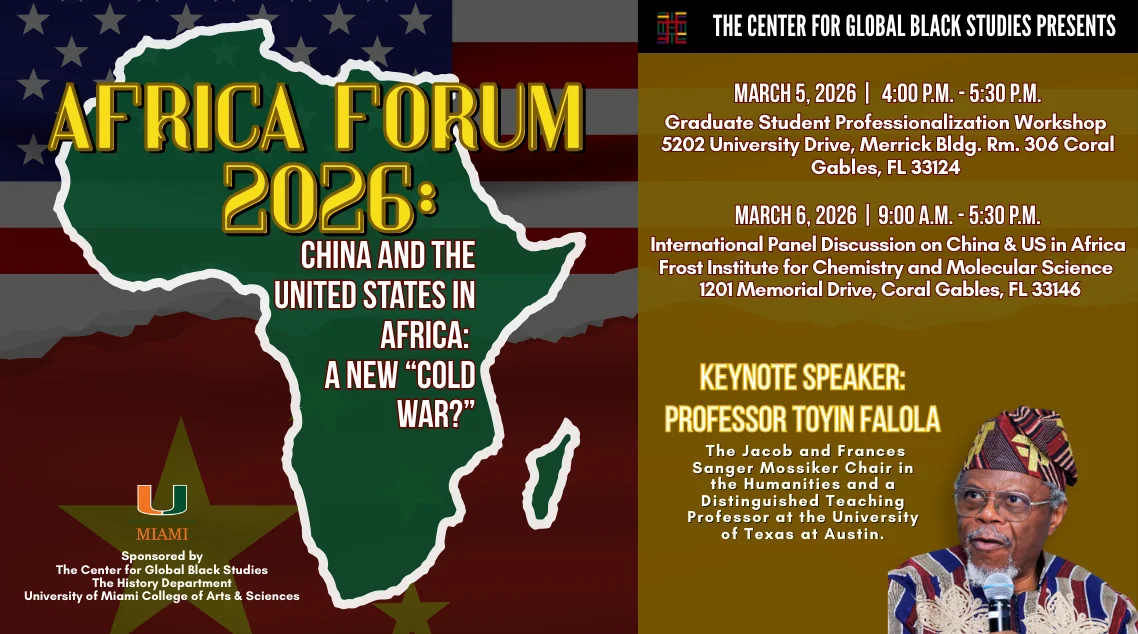
Join us for a one-day symposium that focuses on the theme "China and the United States in Africa: A New 'Cold War?'" Presentations and discussion will address the historical paths that have established the presence of two powerful countries and their impact on Africa. Featured keynote speaker is Dr. Toyin Falola, an acclaimed scholar in African History from the University of Texas along with panel discussions and breakout sessions for students and faculty.
The United States may have one of the world's strongest economies. Still, in terms of leveraging its economy to foster economic relationships and investment in Africa, it presently ranks a distant second to China. Russia is also leveraging its military resources to try to outmaneuver the United States in Africa. Europe is also losing ground to China. The United States is underperforming in Africa relative to China and, increasingly, Russia. China has become the largest trading partner and a dominant source of investment in African and South American countries. Of course, the parameters of engagement are different. China has an advantage because of its massive growth and size, but it also does not predicate partnerships and trade on
political issues such as good governance or human rights.
Chinese companies are now leaders in investments in mining, clean energy, information technology, roads, and railways in Africa. These serve to cushion the effects of China’s population growth and economic growth and ensure economic security in the 21st Century, “Silk Road to Africa to ensure global dominance.” However, reports of Chinese economic coercion and overcapacity are harming domestic industries in some Western and Eastern African countries.
In Ghana, all the major rivers have been polluted by mining led by Chinese nationals and companies. Chinese nationals who have moved into rural areas are engaged in mining and are gradually entering the retail sector. In the capital, Accra, as in other African cities, China Malls are gradually becoming part of the urban landscape, selling Chinese-manufactured goods that are increasingly competing — and sometimes out-competing— local commodities because they are cheaper, albeit sometimes of questionable quality.
In 2022, the United States launched a Minerals Security Partnership, including several European countries and major African mineral-producing countries, such as the Democratic Republic of the Congo and Zambia, to invest in sustainable critical mineral supply chains. This is because the United States, Europe, and a few Asian countries involved in that partnership are concerned about the implications of over-dependence on China as the leading supplier of critical minerals and investment in such minerals. Thus, the partnership strengthens alternative supply chains for critical rare-earth minerals and reduces reliance on China. Thus, the United States is working to diversify the supply chain through targeted infrastructure investment. But these have long gestation periods, are expensive, and are labor-intensive.
This symposium seeks to analyze Chinese-US engagement in Africa in terms of economic and geo-strategic significance. It argues that Africa is increasingly becoming a site for a new “Cold War” or “Hot War” between the United States and China as they battle for global supremacy.
Special professionalization session for graduate students will also be offered and a call for papers and presentations will launch soon.